

Private jet travel is not a binary luxury-or-waste decision. It is a logistics tool, and like any tool, its value depends on whether the situation calls for it. A CEO flying solo from New York to Chicago for a routine board meeting does not need a charter. Four executives visiting three manufacturing facilities across the Southeast in a single day almost certainly do.
The difference between those two scenarios is the difference between spending money and investing it. This guide lays out the specific conditions where private aviation earns its cost, what that cost actually looks like in 2026, and when upgrading to commercial first class delivers better value.
What you need to know:
- Private jet travel makes financial sense when multi-city itineraries, team travel, or deal-critical timing would otherwise require two or more commercial travel days.
- Light jet charter rates in 2026 run $3,000 to $4,500 per flight hour. Midsize jets run $4,000 to $8,000. Heavy jets start at $8,000 and climb past $15,000.
- The real cost comparison is not charter price versus one airline ticket. It is the charter price split across all passengers versus the combined cost of commercial premium fares plus lost executive time.
- According to Morgan Stanley’s 2026 corporate travel survey, 10% of companies now report more permissive private jet policies, up from 4% at midyear and 2% a year earlier.
- For solo travelers on high-frequency routes, commercial first or business class almost always wins.
When does private jet travel make business sense?
Executives we work with most often make the switch to private when their itinerary hits three cities in two days. That is the inflection point where commercial connections start costing more in executive time than the charter costs in dollars.
Multi-city itineraries are the strongest use case. Four executives visiting three facilities can complete the circuit in a single day by private jet. The same itinerary on commercial flights typically requires three to four days once you factor in connections, overnight stays, and the scheduling constraints of airline timetables. Private aviation opens access to more than 5,000 airports in the United States, compared with roughly 500 served by commercial carriers. That airport density is what makes single-day multi-stop trips possible — you land closer to the destination and skip the ground transport buffer.
Team travel shifts the economics further. A charter is a fixed cost regardless of whether two or eight executives are aboard. When three or more senior leaders are traveling together, the per-person cost of a light or midsize jet starts approaching the combined cost of last-minute commercial business class tickets.
Deal-critical timing is harder to quantify but easier to recognize. We have arranged same-day round trips for deal teams who needed four hours on the ground with a target company and could not afford the overnight that commercial schedules would have required. When the deal value runs into eight or nine figures, the charter cost is a rounding error.
Security and confidentiality round out the case. Board members discussing material nonpublic information, executives traveling to sensitive negotiations, or leaders visiting politically unstable regions all have legitimate reasons to avoid commercial terminals. Private FBOs (fixed-base operators) provide discreet arrival and departure without public-facing security lines or gate areas.
What does executive jet travel actually cost in 2026?
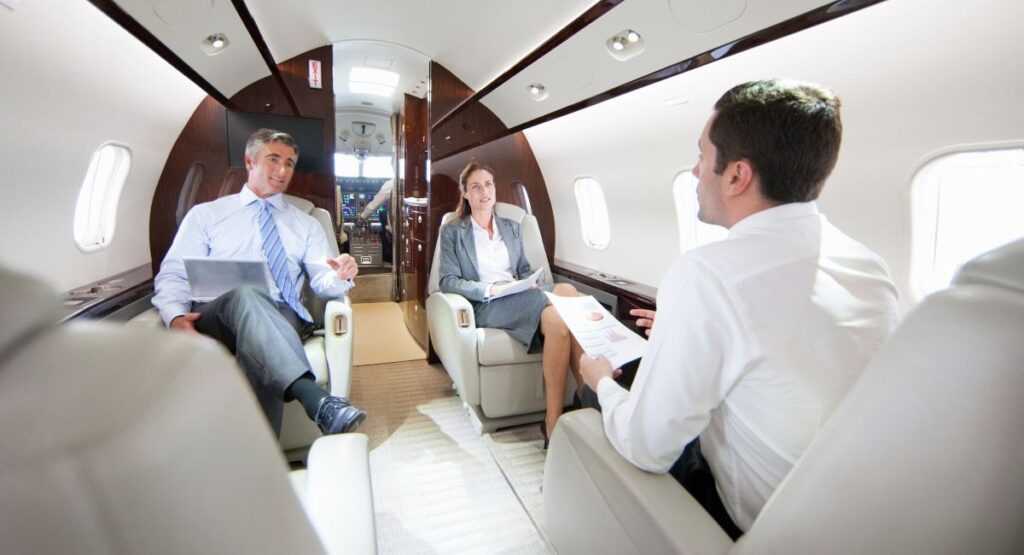
Hourly charter rates vary dramatically by aircraft category. According to Simple Flying’s 2026 rate analysis, these are the current ranges:
| Aircraft Category | Passenger Capacity | Hourly Rate (2026) |
| Light jet (Citation CJ3+, HondaJet) | 4–8 | $3,000–$4,500 |
| Midsize jet (Citation Latitude, Challenger 350) | 7–10 | $4,000–$8,000 |
| Heavy jet (Gulfstream G450, Falcon 900) | 10–14 | $8,000–$15,000 |
| Ultra-long-range (G650ER, Global 7500) | 12–19 | $18,000–$20,000+ |
The hourly rate is not the final number. Add the federal excise tax at 7.5%, fuel surcharges that typically run 10 to 15% above the base rate, segment fees, FBO landing and handling fees, crew overnight expenses on multi-day trips, and catering. A three-hour light jet charter quoted at $4,000 per hour ($12,000 base) can reach $15,000 to $16,000 after all fees land on the invoice.
For companies flying private frequently, the ownership and access models matter. The National Business Aviation Association identifies the threshold for fractional ownership at roughly 100 to 150 flight hours per year. Below 50 hours annually, on-demand charter through a managed travel program is the most cost-efficient structure. Below 25 hours, charter remains the clear choice — the fixed costs of ownership or fractional shares cannot be justified.
How do you calculate the ROI of flying private?
The ROI framework has three components: time value, productivity gain, and opportunity cost.
Time value is the most straightforward. Industry data shows that private jet travel saves an average of approximately 127 minutes per flight compared with commercial — time recaptured from airport security, boarding procedures, connections, and ground transport on both ends. Multiply those saved hours by the executive’s fully loaded compensation rate. A C-suite executive whose time is valued at $500 to $1,000 per hour recovers $1,000 to $2,100 in time value per flight before considering any productivity gain.
Productivity gain compounds the time savings. Research indicates a 50% or greater increase in productive work time on private flights compared with commercial travel. Private cabins function as mobile offices: confidential calls, deal preparation, and team strategy sessions happen in flight rather than in cramped airline seats with passengers on either side. For a deal team preparing for a morning presentation, the flight itself becomes billable preparation time rather than dead hours.
Opportunity cost is the factor most companies undervalue. The question is not just “what did we spend on the charter?” but “what would it have cost us to not be there?” When a plant inspection prevents a $2 million quality failure, or a face-to-face meeting closes a contract that a Zoom call would not have, the charter cost disappears into the return. In our experience, the companies that get the best ROI from private aviation are not the ones that fly private for everything — they are the ones that match the travel mode to the mission.
To calculate ROI for a specific trip: add the time-value recovery, the productivity premium, and any quantifiable opportunity gain. Subtract the total charter cost including all fees. A positive number means the flight paid for itself in executive productivity alone. Use GSA per diem rates as a baseline for the commercial travel costs you are comparing against — they provide a standardized benchmark for lodging and meals that eliminates guesswork.
When is commercial first class the better investment?
Private aviation is not always the answer, and a credible travel advisor will tell you when it is not.
Solo travel on high-frequency routes almost never justifies a charter. New York to Los Angeles, Chicago to Dallas, San Francisco to Seattle — these routes have hourly departures in premium cabins at a fraction of charter cost. A $5,000 first class ticket gets one executive the same lie-flat seat and productivity time that a $15,000+ charter would provide, without the scheduling overhead of arranging the aircraft.
Advance-bookable trips favor commercial. When the travel date is set weeks in advance and the itinerary is a simple round trip, commercial business or first class offers strong value. Charter economics improve with complexity and urgency; simple, planned trips do not generate enough time savings to offset the price gap.
Short flights under two hours compress the time savings that justify private travel. The 127-minute average savings shrinks on short routes where commercial check-in and boarding represent a smaller share of total travel time. A 90-minute flight from Boston to Washington, D.C. saves perhaps 45 minutes by going private — not enough to justify a $10,000+ premium over a $400 shuttle fare.
High-frequency individual travelers are better served by airline loyalty programs and corporate travel management services that negotiate preferred rates. An executive flying 100 segments per year on commercial carriers builds status that delivers upgrades, lounge access, and priority boarding — benefits that reduce the friction private aviation is designed to eliminate.
The smartest executive travel programs do not default to one mode. They use travel reporting and analytics to identify which trips generate ROI from private and which trips should stay commercial. That data-driven matching is where a managed travel program earns its value — not by booking everything on the same type of aircraft, but by putting the right travel mode against the right mission.
Ready to evaluate whether private jet travel fits your executive travel program? Contact our team to build a cost comparison against your current travel patterns, or explore Worldgo’s private jet services to see how on-demand charter integrates with a managed corporate travel program.
About This Guide
This guide draws on Morgan Stanley’s 2026 corporate travel trends survey for policy adoption data, the National Business Aviation Association for fleet and access model benchmarks, Simple Flying’s 2026 charter rate analysis for current hourly pricing by aircraft category, and GSA per diem rates for commercial travel cost baselines. Cost figures reflect mid-2026 market conditions and may shift with fuel prices and seasonal demand. Worldgo is a travel management company — we do not operate or own aircraft.
Frequently Asked Questions
Charter costs depend on aircraft size and flight time. In 2026, light jets run $3,000 to $4,500 per flight hour, midsize jets $4,000 to $8,000, and heavy jets $8,000 to $15,000. Add 7.5% federal excise tax, fuel surcharges of 10 to 15%, and FBO handling fees. A three-hour light jet charter typically totals $15,000 to $16,000 after all costs.
Private aviation makes financial sense when multiple executives travel together, the itinerary covers three or more cities, or timing is deal-critical. The breakeven shifts in private’s favor once the per-person charter cost (total cost divided by passengers) approaches the combined cost of commercial premium fares plus the value of executive time saved.
Industry benchmarks place the fractional ownership threshold at 100 to 150 flight hours annually. Below 50 hours, on-demand charter through a managed travel program is more cost-efficient. Below 25 hours per year, charter is the clear choice — the fixed costs of ownership shares cannot be justified at that volume.
Private jet travel saves approximately 127 minutes per flight on average compared with commercial. The savings come from eliminating airport security lines, boarding procedures, layover connections, and the ground transport buffer between commercial airports and final destinations. Access to 5,000-plus airports versus roughly 500 commercial airports also reduces ground travel time.
Business-purpose private jet travel is generally deductible as a transportation expense, subject to IRS rules on business purpose documentation and the entertainment use limitations that apply to company-owned or leased aircraft. On-demand charter for documented business travel is typically deductible at cost. Consult a tax advisor for company-specific guidance.
A travel management company evaluates each trip to determine whether private charter, commercial first class, or business class delivers the best ROI. Worldgo provides access to on-demand charter networks, negotiates rates, handles logistics and ground transport coordination, and provides consolidated reporting so companies can track private versus commercial spend patterns across their executive travel program.


